
Ipsoprubart (ELA026)
Ipsoprubart (ELA026)
Ipsoprubart (ELA026): Targeted Depletion of Activated T Cells and Myeloid Cells
Ipsoprubart is a novel fully human IgG1 monoclonal antibody that binds to SIRPα and SIRPβ1 on myeloid cells and SIRPγ on T cells, immune cells that are principally responsible for driving the cytokine storm in severe hyperinflammatory conditions, including secondary hemophagocytic lymphohistiocytosis (sHLH). Because SIRP expression is elevated on activated disease-driving cells, ipsoprubart is designed to preferentially deplete these pathogenic cells while sparing resting and recovering immune cell populations.
We are currently evaluating ipsoprubart in a global registrational program as a first-line treatment for sHLH, a rare and life-threatening hyperinflammatory disease for which there are no broadly approved therapies.
We are also evaluating ipsoprubart in a Phase 1 clinical trial in patients with T cell and natural-killer cell malignancies.

Treating sHLH, Offering Hope
Secondary hemophagocytic lymphohistiocytosis (sHLH) is a life-threatening inflammatory disease that can be triggered by malignancy, infection, autoimmune disease, or immunotherapy. sHLH is associated with a systemic hyperinflammatory response for which patients require immediate medical intervention. Without treatment, it can rapidly progress from symptoms such as persistent fever, hepatomegaly and/or splenomegaly, and cytopenias, to multiorgan failure and death.1,2
There are no approved therapies for sHLH broadly. Current treatments used for sHLH are associated with significant long-term toxicity and limited efficacy.3,4 Even with these treatments, sHLH has high mortality during the first few months.5 Malignancy-associated HLH (mHLH) is the largest subtype of sHLH, and associated with poorest outcomes, with a mortality rate of approximately 50% at 2 months.6
There are no approved therapies for sHLH. Current off-label treatments for sHLH carry significant long-term toxicity and limited efficacy.3,4 Even with these treatments, sHLH has high mortality during the first few months.5 Malignancy-associated HLH (mHLH) is the deadliest amongst the subtypes of sHLH, with a mortality rate of approximately 50% at 2 months.6

~50% Fatality
Within 2 months for
Malignancy-Associated HLH
Ipsoprubart Targets the Principal Cells Responsible for Driving Pathogenesis in sHLH

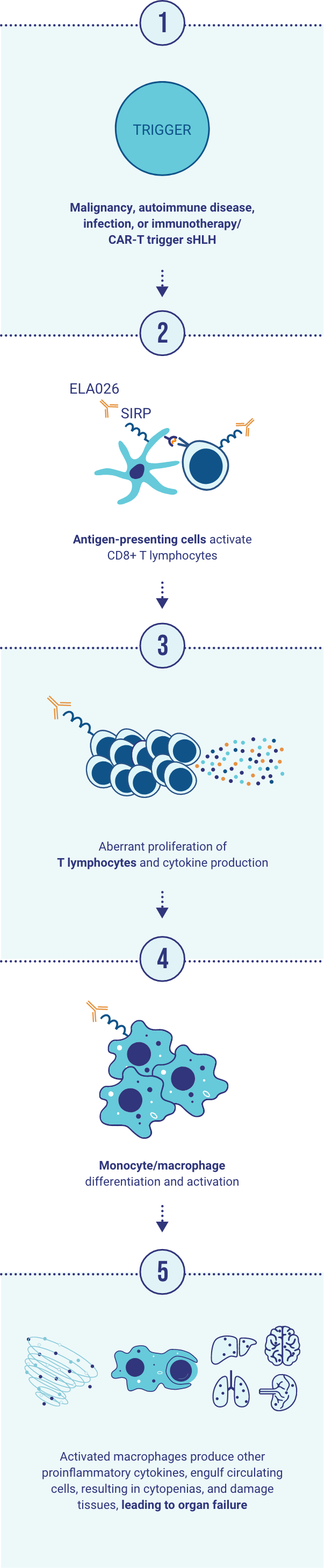
By targeting SIRP on the cell surface of myeloid cells and T lymphocytes, Ipsoprubart depletes the cells responsible for inducing the hyperinflammatory condition in sHLH.
By targeting SIRP on the cell surface of myeloid cells and T lymphocytes, Ipsoprubart depletes the cells responsible for inducing the hyperinflammatory condition in sHLH.
sHLH is a life-threatening disease in need of effective treatments.
Ipsoprubart has the potential to be a transformative treatment for patients with sHLH.
CAR-T=chimeric antigen receptor (CAR)-T cell.
References: 1. Otrock Z, Eby C. Clinical characteristics, prognostic factors, and outcomes of adult patients with hemophagocytic lymphohistiocytosis. Am J Hematol. 2015;90(3):220-224. Doi:10.1002/ajh.23911 2. Trottestam H, Horne A, Aricò M, et al. Chemoimmunotherapy for hemophagocytic lymphohistiocytosis: long-term results of the HLH-94 treatment protocol. Blood. 2011;118(17):4577-4584. Doi:10.1182/blood-2011-06-356261 3. Bergsten E, Horne A, Arico M, et al. Confirmed efficacy of etoposide and dexamethasone in HLH treatment: long-term results of the cooperative HLH-2004 study. Blood. 2017;130(25):2728-2738. Doi:10.1182/blood-2017-06-788349 4. La Rosée P, Horne A, Hines M, et al. Recommendations for the management of hemophagocytic lymphohistiocytosis in adults. Blood. 2019;133(23):2465-2477. Doi:10.1182/blood.2018894618 5. Abdelhay A, Mahmoud A, Mostafa M, et al. Delay in treatment of adult hemophagocytic lymphohistiocytosis is associated with worse in-hospital outcomes. Ann Hematol. 2023;102(11):2989-2996. Doi:10.1007/s00277-023-05271-w 6. Lionel AC, Long JP, Prakash R, et al. Differing Inflammatory Profiles and Survival Outcomes of Cytokine Storm Arising from CAR T-Cell Therapy, Covid, and Malignancy-Associated HLH in Patients with Hematological Malignancies. Poster presented at the American Society of Hematology 2023. Poster: SUN-3507.