
Our Science
Our Science
SIRP Expression as a Marker of Immune Cell Activation
SIRP is a family of cell surface receptors involved in regulating immune homeostasis and inflammatory responses. Their expression is largely restricted to defined immune cell populations and can increase significantly as these cells become activated. This activation-dependent expression pattern creates a molecular marker, or flag, that can be targeted to selectively deplete disease-driving cells while sparing naïve and regulatory immune populations necessary for normal immune function.
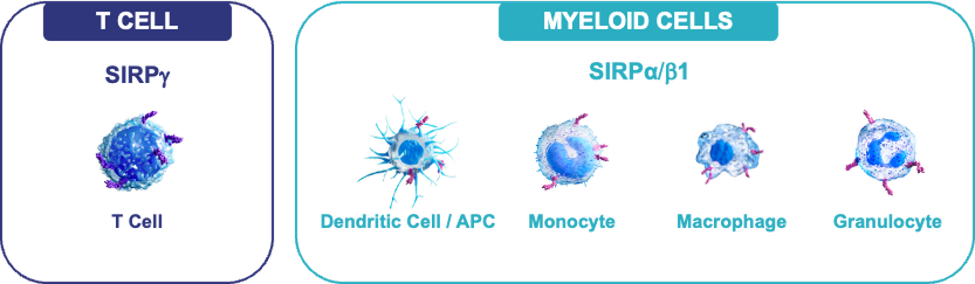
The principal members of the SIRP family include SIRPα and SIRβ1, expressed on dendritic cells and antigen-presenting cells (APCs), monocytes, macrophages, and granulocytes; and SIRPγ, expressed predominantly on T cells, as shown in the figure below:
Our Distinct Approach to Precision SIRP-Targeted Immune Cell Depletion
Our antibodies are designed to selectively bind SIRP-expressing cells without blocking or otherwise modulating CD47-SIRPα signaling. Our approach is to mediate therapeutic activity through antibody-mediated elimination of the bound cell, achieved through antibody-dependent cellular cytotoxicity (ADCC) and antibody-dependent cellular phagocytosis (ADCP), resulting in elimination of the targeted pathogenic cell. Selectivity is enabled by differential SIRP expression between activated cells and naïve or regulatory immune cell populations.
A Portfolio of SIRP-Targeted Antibodies
We have generated a proprietary library of SIRP-targeted antibodies with distinct profiles, developed over years of dedicated discovery and engineering. This platform provides substantial flexibility to align antibody design with the cellular biology and therapeutic objectives of each program, and we believe it positions us to pursue a broad range of indications involving pathogenic SIRP-expressing cells.